Commercial Floor Sanding in South West London SW15
Commercial floor sanding in South West London SW15 is rarely just a matter of taking a machine across worn timber and applying another coat of lacquer. In offices, shops, restaurants, schools, clinics, gyms and public buildings around Putney and Roehampton, we are usually dealing with failed surface protection, ingrained contamination, loose parquet, damaged board edges and traffic lanes that have worn through to bare timber.
Those faults quickly become operational problems. Dirt works into open joints, cleaning becomes harder, exposed timber absorbs moisture and grease, and polished but poorly prepared surfaces can become a slip concern around entrances, bars, washrooms and other high-use areas.
Our work covers complete Commercial Floor Restoration in South West London, planned Commercial Floor maintenance in South West London and specialist Commercial Floor Polishing in South West London. We plan the specification around the timber, building use, expected traffic, cleaning regime and the amount of downtime the site can realistically tolerate.
SW15 contains a broad mixture of properties. We work in Victorian and Edwardian conversions off Putney High Street, older commercial premises near Putney Bridge and the Embankment, institutional buildings, schools and places of worship, as well as modern offices, retail units and managed developments around Upper Richmond Road and Roehampton.
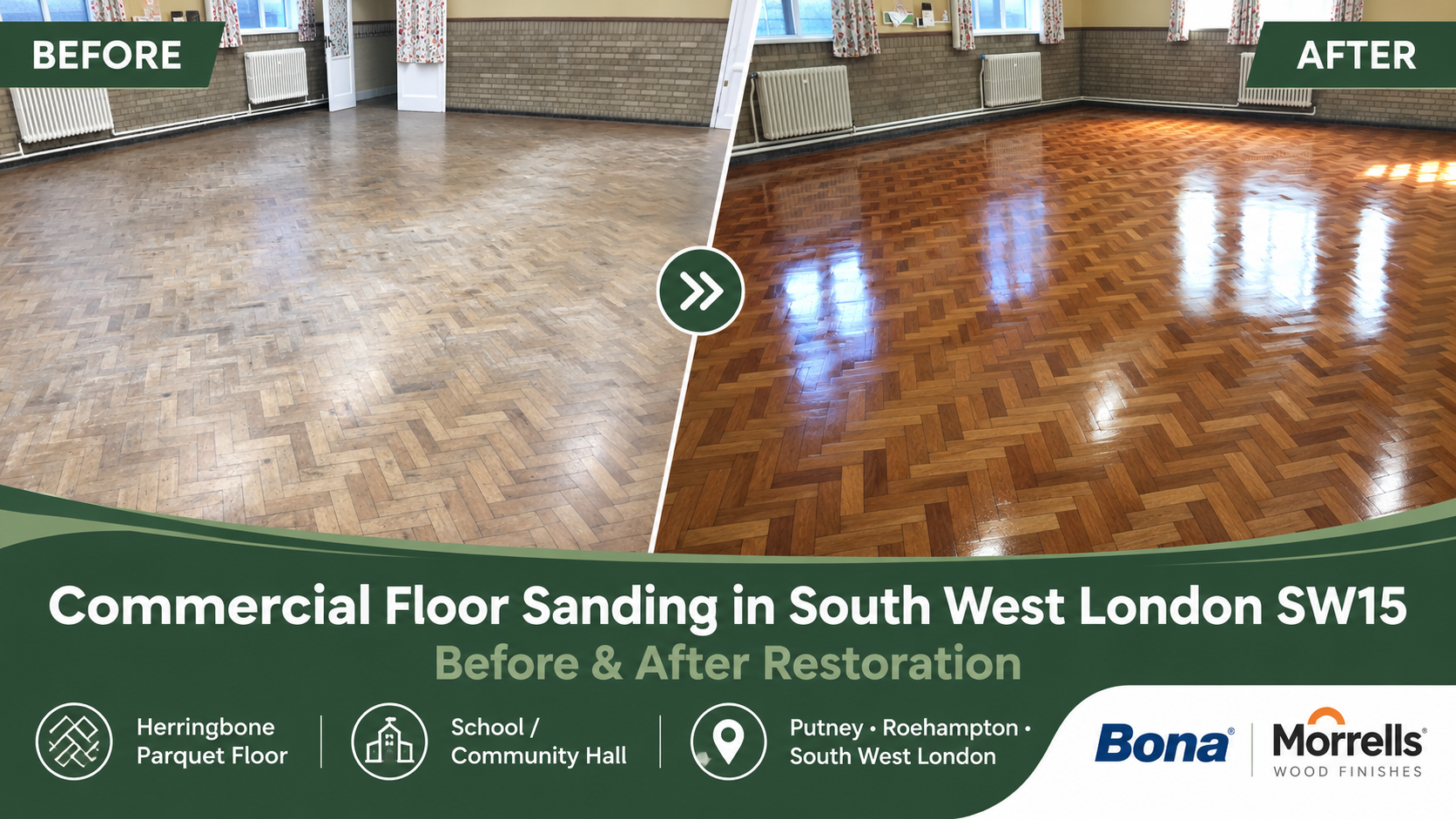
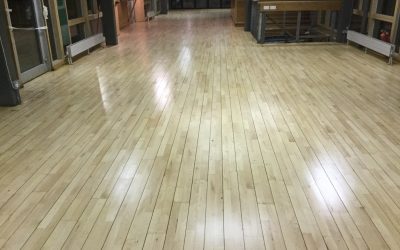
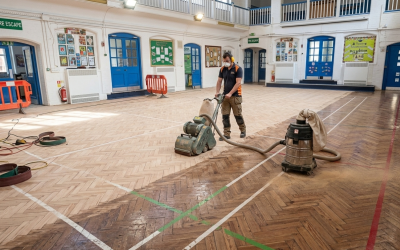
Before and after restoration of a herringbone parquet floor in a school or community hall in South West London SW15.
Commercial Timber Floors Wear Differently from Domestic Floors
A timber floor in a family sitting room and a floor taking hundreds of pairs of shoes, delivery trolleys, office chairs or restaurant covers every day require very different specifications. Domestic-grade polish or a light screening coat will not correct timber that has already lost its protective film or developed movement between boards.
We first identify what is actually on the floor. That may be quartersawn oak strip, pitch pine boards, teak, maple, engineered oak or traditional finger-block and herringbone parquet, each of which sands and accepts fillers and finishes differently.
We also establish what has previously been applied. Old solvent lacquer, wax, hardwax oil, metallised polish, silicone-based cleaning products and repeated maintenance coatings can all affect adhesion if they are not properly removed or isolated.
- Open joints and failed blocks: gaps trap dirt, food debris and cleaning residue and can allow individual parquet pieces to loosen further.
- Moisture ingress: entrance areas, catering spaces, basement floors and timber over damp subfloors can show elevated moisture readings before visible damage appears.
- Traffic-lane wear: reception desks, serving counters, corridors and doorways often wear through several years before the rest of the room.
- Slip performance: an attractive gloss level does not automatically mean a surface is suitable for a busy public or commercial environment.
- Contaminated timber: grease, silicone, wax and chemical cleaners can cause lacquer rejection, fisheyes or poor intercoat adhesion.
- Excessive sanding: older parquet and tongue-and-groove boards have a finite wear layer and should not be aggressively cut simply to remove every historic mark.
Our Commercial Floor Restoration Process in SW15
Step 1: Subfloor Audit & Moisture Testing
Before machinery is unloaded, we inspect the floor construction, access routes, electrical supply, fire exits and the way the premises need to operate during the works. On occupied sites this information feeds directly into the RAMS documentation, work-zone layout and out-of-hours programme.
Timber moisture readings are taken where movement, cupping or staining gives cause for concern. Where the construction or site history warrants it, we also carry out hygrometer checks to establish whether moisture is coming from the subfloor rather than simply from local cleaning or atmospheric conditions.
We do not trap an unresolved damp problem beneath a hard lacquer. If readings suggest an active moisture issue, that needs to be understood before sanding and recoating proceed.
Step 2: Timber Repairs, Re-bonding & Resin Gap-Filling
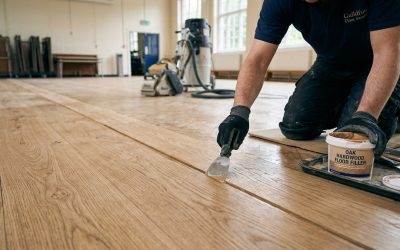
Loose parquet is lifted carefully, the old adhesive is reduced where practical and suitable blocks are re-bonded. Depending on the substrate and floor construction, we may specify a silane-based flexible parquet adhesive, particularly where good bond strength and controlled flexibility are required.
Damaged boards can be pieced in with matching or closely compatible timber rather than filled indiscriminately. On older oak, pitch pine and teak floors, grain direction, board width, age and colour variation matter if a repair is to settle into the surrounding floor after finishing.
For appropriate floors, fine sanding dust from the actual timber can be mixed with a compatible resin binder to form a resin-slurry gap filler. This works well for smaller stable joints; it is not a sensible repair for large seasonal gaps or boards that are still moving.
Step 3: HEPA Dust-Controlled Sanding & Surface Preparation
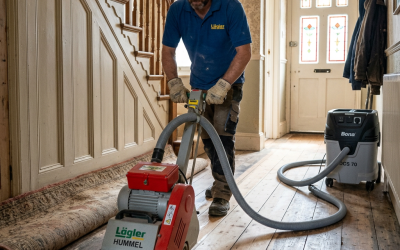
For main field sanding we use professional belt sanding equipment such as the Lägler Hummel, matched with edging and detail machines for walls, thresholds, radiator lines and awkward commercial joinery. Abrasive grades are selected according to the floor condition rather than starting unnecessarily coarse.
Dust control is handled with high-grade extraction, including HEPA H14 filtration where the site specification requires it. No sanding operation is literally dust-free, but properly maintained extraction makes an enormous difference in offices, clinics, schools, retail premises and other buildings where dust migration must be tightly controlled.
The final sanding sequence is critical. Deep abrasive scratches left beneath a clear 2K lacquer will remain visible, particularly across large oak floors under strong shop, office or hospitality lighting.
Before coating, we vacuum thoroughly and inspect edges, repairs, filler lines and machine marks under working light. Contaminated floors may require additional preparation or a change of coating system rather than simply adding another coat and hoping it bonds.
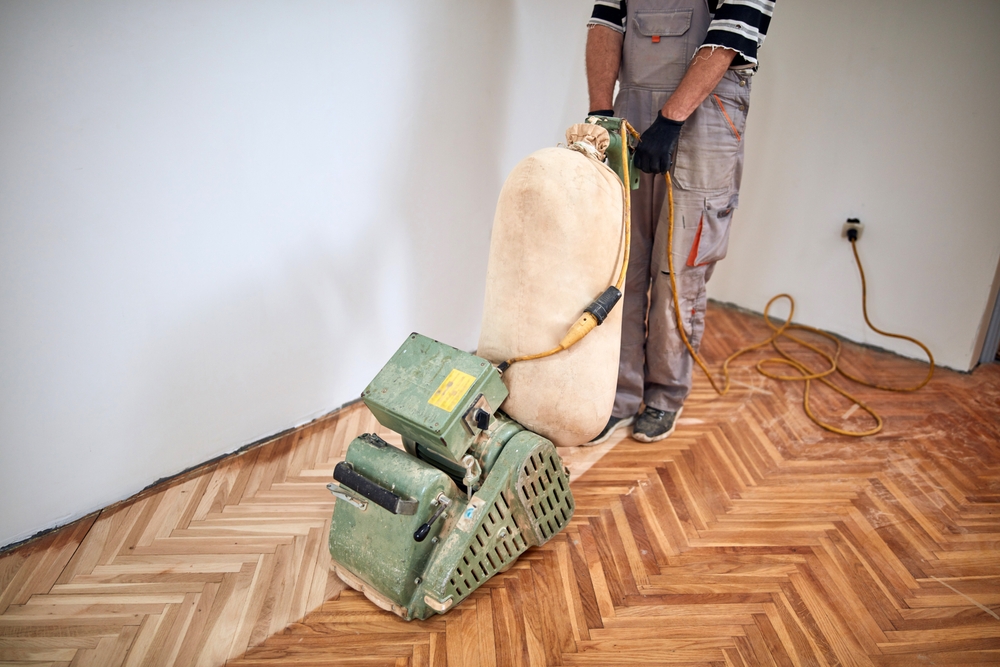
Professional commercial floor sanding in South West London SW15, restoring parquet flooring with specialist sanding equipment.
Do you like this personality?
Step 4: High-Traffic Finishes – 2K Lacquers, Hardwax Oils & Anti-Slip Systems
For many offices, shops, education buildings and hospitality sites, our standard commercial specification is a professional 2K waterborne polyurethane. The second component contains a cross-linking catalyst which produces a tougher cured film than a basic single-pack domestic coating.
Waterborne technology also keeps solvent odour considerably lower than traditional solvent-heavy systems. On sensitive projects we can specify compatible primers, adhesives and ancillary products carrying recognised low-emission classifications such as EMICODE EC1 Plus where this forms part of the project brief.
Hardwax oil remains useful where clients want a more natural timber appearance or prefer a finish that can be locally maintained. It still needs a proper maintenance schedule; a restaurant or retail floor cannot be oiled once and then scrubbed indefinitely with aggressive degreasers.
Where slip resistance is a documented requirement, we discuss the finish manufacturer’s technical data and the conditions in which the floor will be used. Pendulum testing may be specified for relevant pedestrian areas; many facilities teams still refer to BS 7976-2, although that standard has been withdrawn and superseded by BS EN 16165:2021.
That distinction matters because slip performance depends on the whole operating environment, not a tin labelled “anti-slip”. Footwear, contamination, water, grease, cleaning products, surface texture and maintenance all affect the result.
Step 5: Cure Times, Reopening & Aftercare
A lacquer being dry to the touch does not mean it has reached full chemical cure. Light foot traffic may often resume within the coating manufacturer’s stated window, but furniture replacement, rugs, wheeled equipment, wet cleaning and heavy commercial traffic can require longer.
We set those timings out before work starts so the facilities manager knows when each zone can realistically return to service. On multi-stage projects, that may mean sanding one section overnight, coating it before handover and keeping it isolated while the next section remains operational.
After completion we provide practical cleaning guidance based on the finish applied. Correct pH-neutral cleaning, controlled moisture use and periodic maintenance coats will normally cost less than waiting until bare timber is visible again.
Commercial Floor Sanding for Offices, Retail, Hospitality & Public Buildings
Our commercial sanding work in South West London SW15 covers private offices, serviced offices, coworking spaces, shops, boutiques, showrooms and shopping-centre units. We also work in restaurants, cafés, pubs and takeaway premises where timber is exposed to chair movement, food grease, frequent mopping and concentrated wear around service routes.
Industrial and operational environments require a different approach. Workshops, light manufacturing units, storage areas, distribution premises and delivery depots may require repairs and durable protection focused more on serviceability than decorative perfection.
We also restore timber floors in gyms, studios, cinemas, event spaces, hotels, hostels and serviced accommodation. Clinics, dental practices and treatment rooms typically need tighter dust management and careful product selection because surrounding rooms may remain operational.
Schools, colleges, universities and academies often need work phased into holidays, evenings or weekends. Churches, mosques and temples present their own access and programming issues, particularly where large congregational spaces cannot be unavailable for extended periods.
Working Around Live Commercial Sites in South West London
The sanding itself is only part of a commercial job. Deliveries, loading restrictions, alarms, lift access, fire routes, building managers, neighbouring tenants and reopening deadlines all have to be incorporated into the programme.
Putney High Street is a good example. Retail and hospitality units can sit beneath offices or residential accommodation, which means noise windows, dust containment and machinery movements have to be agreed rather than treated like an empty domestic property.
Properties near Putney Embankment and surrounding conservation areas can also contain older floors and historic fabric that need a less aggressive repair approach. We remove only as much timber as necessary to achieve a sound, finish-ready surface.
| Working Arrangement | Operational Benefit | Typical Facility Suitability |
|---|---|---|
| Overnight Shift | Main sanding and coating work carried out after staff or customers leave, reducing disruption during trading hours. | Offices, shops, restaurants, cafés, clinics, gyms and reception areas. |
| Weekend Phased | Allows larger areas to be completed while providing a longer curing window before Monday occupation. | Serviced offices, schools, colleges, showrooms, studios and public-facing commercial premises. |
| Sectional Working | The floor is divided into controlled work zones so part of the building can remain operational. | Hotels, coworking spaces, large offices, education sites, places of worship and multi-room facilities. |
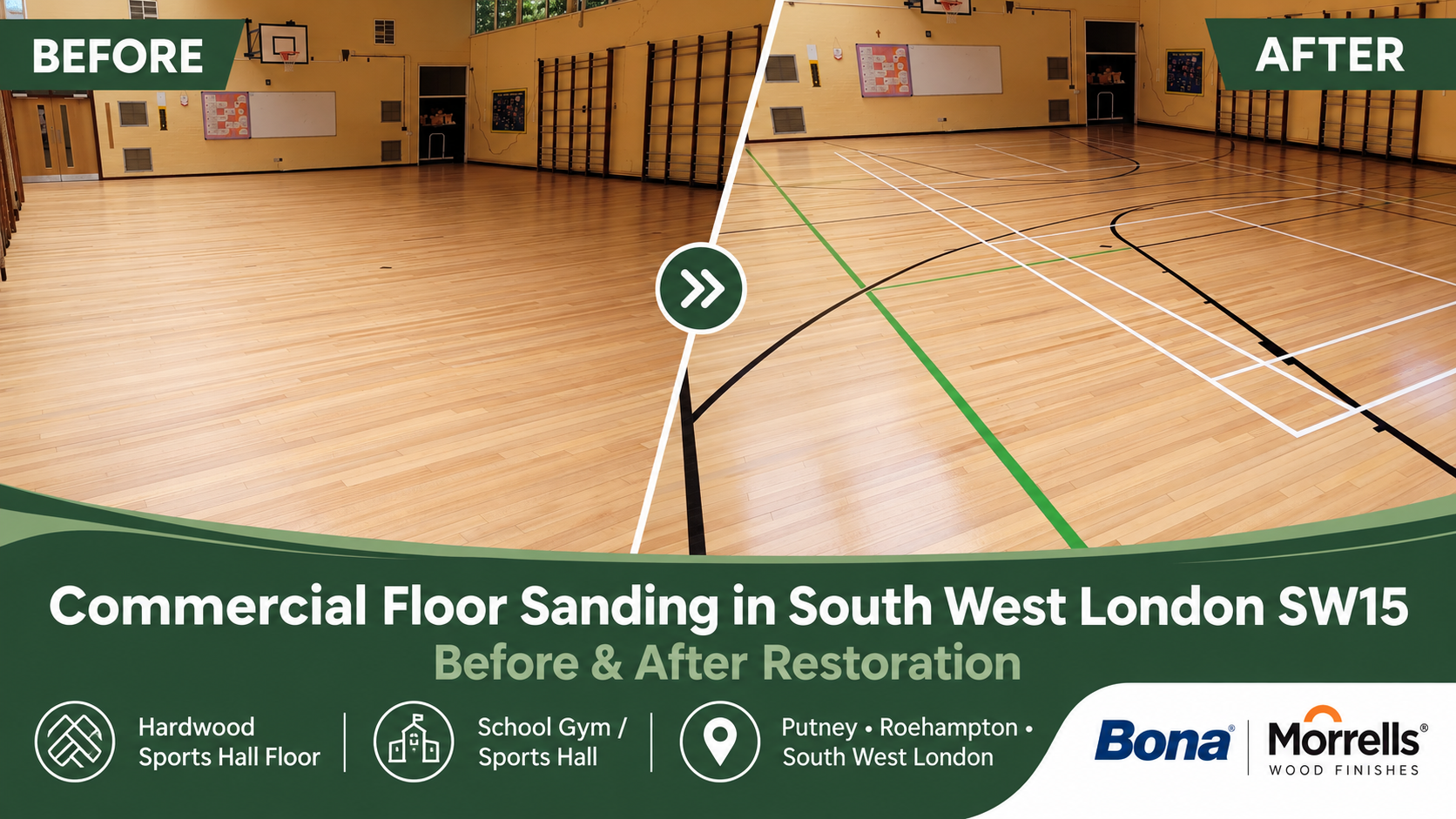
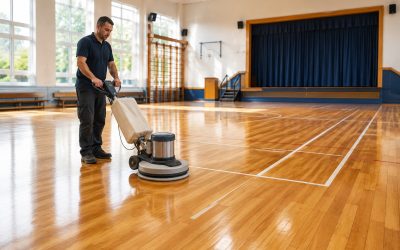
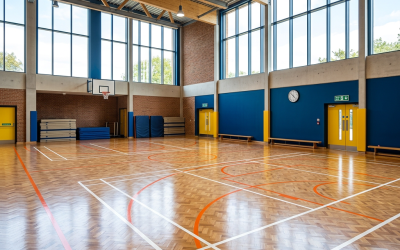
Before and after restoration of a hardwood school sports hall floor in South West London SW15, showing the refinished timber surface and completed multi-sport court markings.
RAMS, COSHH and Commercial Site Safety
Commercial floor sanding needs more than a risk assessment copied from a domestic job. Where required, we prepare site-specific RAMS covering machinery use, dust control, work-zone segregation, manual handling, electrical equipment, emergency arrangements and access management.
COSHH assessments are considered for lacquers, hardeners, cleaners, adhesives, fillers and other chemical products brought onto site. Safety data sheets can be supplied to facilities or principal contractors where required.
Pedestrian routes and fire exits must remain properly managed throughout phased work. Fresh coating areas are physically isolated and clearly identified; relying on a handwritten “wet floor” sign beside uncured lacquer is not an adequate commercial control measure.
Why Surface Polishing Alone Often Fails
Machine polishing has its place when an existing finish is intact and compatible with the maintenance system. It cannot rebuild a lacquer film that has worn through to bare timber, tighten loose parquet or remove deep contamination.
Applying polish over grease, silicone residue or fractured old coating can make the floor look better for a short period while leaving the underlying failure untouched. In some cases it creates additional work because every maintenance layer must later be removed before a proper restoration coating can bond.
Where full sanding is not required, we will say so. A deep clean, mechanical key and maintenance coat can be a cost-effective option when the underlying finish still has sufficient integrity.
Commercial Floor Maintenance After Restoration
The maintenance schedule should be agreed before the floor starts wearing again. Entrance matting, chair protection, sensible cleaning chemistry and planned maintenance coats make a measurable difference to the useful life of the finish.
Reception desks, bar fronts, serving areas and main walking routes should be inspected more frequently than low-traffic corners. Treating these wear zones before the coating disappears completely can avoid another full sanding cycle.
If you are budgeting a project, see our floor sanding prices for general cost guidance. Commercial quotations are site-specific because working hours, access, floor condition, repairs, coating specification and the number of phases can change labour requirements substantially.
You can also view our floor sanding gallery to see the type of timber surfaces and restoration work involved before requesting a survey.
Experienced Commercial Floor Sanding Team
Commercial work is carried out by experienced operatives, with CSCS-carded staff deployed where the site or principal contractor requires it. Appropriate commercial public liability insurance is maintained for the work we undertake, and documentation can be provided as part of the pre-start process.
For initial pricing, we normally ask for clear photographs or a short video showing the full floor, damaged areas, thresholds and access. Floor plans are useful on offices, schools, hotels and larger commercial buildings because they allow us to estimate phasing and working zones before attending.
A physical site survey is then used where necessary to verify floor area, timber condition, access, repairs, power requirements, moisture concerns and coating specification. That gives the client a transparent quotation based on the work actually required rather than an unrealistic square-metre figure that grows once machinery arrives.

Arrange a Commercial Floor Survey in South West London SW15
If your office, shop, restaurant, school, clinic, hotel or commercial premises has worn lacquer, loose parquet, damaged boards or a floor that can no longer be cleaned properly, call us before deciding whether it needs complete sanding.
Call 0800 335 7565 to discuss the site, working hours and required completion date.
You can also send photographs, a short site video or floor plans by WhatsApp or email for an initial assessment. For larger or technically uncertain floors, we will arrange a physical survey before issuing the final specification and quotation.